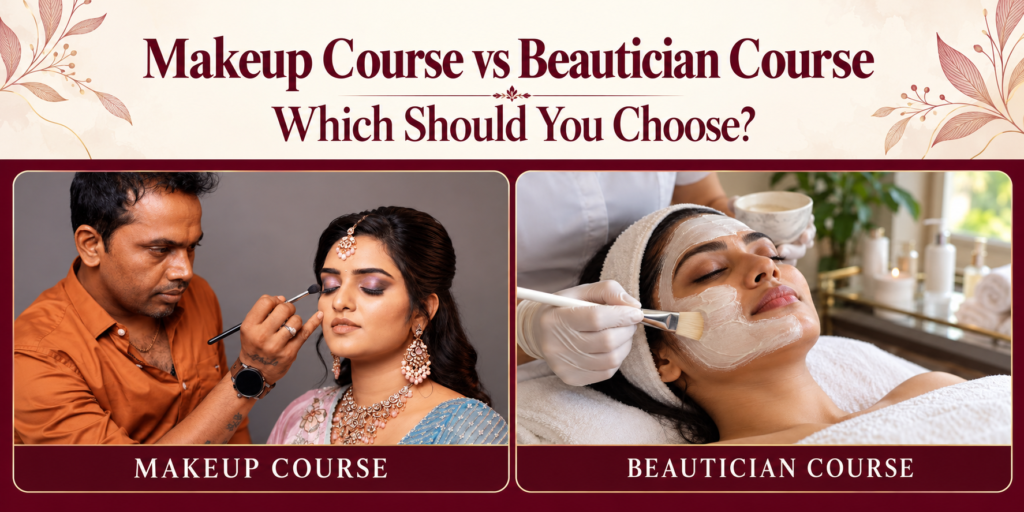
Choose a makeup course if you want to specialise in bridal, occasion or professional makeup. Choose a beautician course if you want broader skills in skincare, facials, hair removal, manicure, pedicure and everyday salon services. If both interest you, start with the course that matches the services you want to offer first.
For beginners, these course names can feel confusing. Both belong to the beauty industry, involve working with clients and require practical training. However, their main focus differs.
For beginners, these course names can feel confusing. Both belong to the beauty industry, involve working with clients and require practical training. However, their main focus differs.
What Is a Makeup Course?
A makeup course focuses on preparing the face, choosing suitable products and creating a finished look for a particular person and occasion.
Professional training should develop more than the ability to copy a demonstration. You should understand why a foundation matches, how undertones affect product selection and how to adapt techniques to different features.
Topics commonly covered include:
- Skin preparation, skin types and undertones.
- Product knowledge, brushes and hygiene.
- Foundation matching, correction and concealing.
- Eye makeup, eyebrows and lash application.
- Blush, contour, highlighting and lip techniques.
- Bridal and occasion looks.
- Setting, finishing and client consultation.
Advanced techniques, airbrush makeup, hairstyling and saree draping are not automatically included in every makeup course. Ask for the written syllabus.
For example, a learner planning to offer wedding makeup needs practice creating complete looks, maintaining consistency and working within an event schedule.
What Is a Beautician Course?
A beautician course usually develops a wider range of beauty-service skills. Depending on the programme, it may cover skincare, facials, threading, waxing, manicure, pedicure, basic makeup and salon working practices.
The Beauty & Wellness Sector Skill Council’s Beauty Therapist qualification describes a role that includes skincare, makeup, hair removal, and manicure and pedicure services. This shows that beauty therapy can include makeup, although a particular academy’s syllabus may differ.
Typical learning areas include client consultation, product selection, service preparation, hygiene and the sequence of each treatment.
Haircuts, colouring, nail extensions and advanced equipment-based services should never be assumed to be included. These may require separate training.
A learner who wants to offer several everyday beauty services may therefore find a beautician course more suitable than a programme focused primarily on makeup.
Makeup Course vs Beautician Course: Key Differences
| Comparison | Makeup course | Beautician course |
|---|---|---|
| Main focus | Creating professional makeup looks | Providing a range of beauty services |
| Typical skills | Base, correction, eyes, bridal and occasion makeup | Facials, threading, waxing, manicure and pedicure |
| Makeup coverage | Usually the central subject | May include basic or broader makeup modules |
| Potential work direction | Bridal, freelance, occasion or studio makeup | Salon beauty services or a beauty-service business |
| Useful work evidence | Clear photographs of completed looks | Practical assessments and service competence |
| Best fit | Learners seeking makeup specialisation | Learners seeking broader beauty-service skills |
Neither course is automatically better. The right choice depends on your interests, the actual training and your first career goal.
Which Course Matches Your Career Goal?
Choose makeup if you want to specialise in complete looks
A makeup course may suit you if you enjoy colour, detail, facial features and creating looks for weddings, celebrations or photography.
Imagine your first intended service is engagement makeup. Your training should help you understand the client’s preferences, prepare the skin, choose a suitable base and finish the look professionally.
You will also need consultation skills, time management and practice beyond classroom demonstrations.
Choose beauty training if you want several salon services
A beautician course may suit you if you enjoy skincare routines, grooming and performing a variety of services.
For example, someone planning to work in a salon may want to learn facials, threading, waxing and hand and foot care before specialising further.
Compare the depth of each module. A long list of services is useful only when students receive sufficient practice and feedback.
Consider both if you want a broader business
Some learners eventually want to offer makeup alongside routine beauty services. You can build those skills in stages.
Start with the services you intend to provide first, practise them properly, and then add another course. This approach can make your training budget and learning schedule easier to manage.
Can Beginners Join Either Course?
Many foundational programmes accept beginners, but entry requirements vary. Ask whether the course starts with basic product knowledge and technique or expects previous training.
Being interested in makeup does not mean you must already know professional application. Similarly, enjoying skincare does not mean you understand salon service procedures.
Useful habits include patience, attention to detail, cleanliness and willingness to practise after receiving corrections.
Before joining, ask how the academy supports students who need additional help. A demonstration is valuable, but supervised practice reveals whether you can perform the technique yourself.
How to Compare Course Duration and Fees
There is no single duration or fee that applies to every makeup or beautician course. Compare what the programme includes rather than choosing only by its number of days.
Request written answers to these questions:
- What are the total teaching and practical hours?
- How often are classes held?
- What is the batch size?
- Are products, tools and practice materials included?
- Who arranges practice models?
- Are assessment and certificate charges included?
- What are the cancellation and refund terms?
For Hyderabad learners, travel also matters. A convenient location can make regular attendance easier, especially when classes run several days each week.
Calculate your total cost, including transport and any kit purchases. A lower advertised fee may not be the lower overall expense.
What Should You Check in the Certificate?
Ask who issues the certificate and what it confirms. An academy course-completion certificate and a certificate awarded through a recognised qualification system are different.
If an institute advertises affiliation or recognition, request the exact awarding body, qualification name and evidence that applies to your chosen programme.
Avoid choosing solely because the word “international” appears in the course title.
Also ask how students are assessed. Practical assessment helps show whether you can apply the skills taught. Completing a course does not, by itself, guarantee a job, bookings or a particular income.
Why Hands-On Practice Matters
For makeup training, useful practice involves different faces, undertones and requested finishes. One successful look on one model does not demonstrate that you can adapt consistently.
For beauty training, practice should include consultation, workstation preparation, service sequence, client comfort and cleaning afterwards.
Hygiene belongs in both courses. Ask to observe how products and tools are handled during a class, rather than relying only on a brochure’s promise.
Trainer feedback should explain what needs correction and why. For instance, identifying a foundation mismatch is more useful than simply saying that a look needs improvement.
What Career Opportunities Can Each Course Support?
Makeup training can support a path towards bridal, occasion, freelance or salon-based makeup work. Broader beauty training can support beauty-service roles in salons or the development of your own service business.
These are possible directions, not guaranteed outcomes.
Your opportunities will also depend on skill, reliability, local demand, client communication and continued practice.
If you plan to freelance, learn how to discuss requirements, confirm bookings and explain service inclusions. If you plan to work in a salon, practise professional conduct and teamwork.
Ask academies to explain precisely what their career support includes. Guidance, interview assistance and guaranteed employment are different promises.
Explore Makeup and Beauty Training at Cheritan
Cheritan Makeup Studio & Academy offers separate makeup and beauty course pages for learners in KPHB, Hyderabad, near KPHB Metro Station.
Its Professional Makeup Course describes training in preparation, base, correction, eye makeup, bridal looks and finishing.
Its Professional Beauty Course covers areas including facials, threading, waxing, manicure, pedicure and salon basics.
Compare both syllabuses and contact Cheritan for current duration, fees, timings and certification details. During an academy visit, ask to see practical training and student work.
Frequently Asked Questions
Is a beautician course the same as a makeup course?
No. A beautician course generally covers several beauty services, while a makeup course specialises in makeup. Some subjects overlap.
Which course should I choose for bridal makeup?
Choose a programme with detailed bridal makeup teaching and supervised complete-look practice. Confirm whether hairstyling and draping are included.
Can I learn makeup after a beautician course?
Yes. Makeup specialisation can be a later step. Choose a level that builds on what you already know.
Which course offers better income?
Neither guarantees higher income. Earnings depend on your skills, services, experience, location, expenses and ability to attract or retain clients.
How do I make the final decision?
Choose the work you want to do first, compare written syllabuses and observe a practical class. Enrol when the training, support and total cost match your goal.